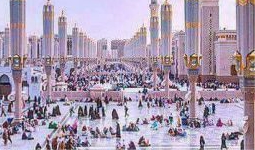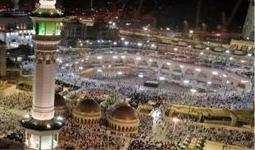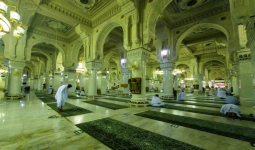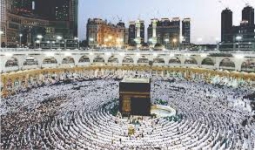
The Zamzam Well (Arabic: بئر زمزم) is a well located in the Masjid al-Haram in Mecca, Saudi Arabia. It is located 20 m (66 feet) east of the Kaaba,the holiest place in Mecca. Hagar (Hajar) around 1953 extracting water from the Zamzam (prevent-prevent) well.
In Islamic narrations, the belongings is a miraculously generated delivery of water that unfold out loads of years ago while Ismaʿil (Ishmael), the son of Ibrahim (Abraham), was left together with his mother, Hajar (Hagar), within the barren area.
"The blessed water at the face of the earth is the water of Zamzam. Prophet Muhammad (PBUH), Sahih al-Bukhari"
The Prophet Ibrahim (Abraham, peace be upon him) modified into commanded via Allah to go away his spouse Hagar (Hajar) and their little one son Ishmael (Ismail) in the barren, desolate valley of Mecca, an area without a water, no plant life, and no human beings. He left them with a small quantity of food and water, then grew to come to be a tourist.
Hagar referred to him: "O Ibrahim! Where are you going, leaving us in this valley in which there may be no individual and nothing?" She repeated this numerous instances; but Ibrahim persisted in strolling. Finally, she requested, "Has Allah commanded you to do that?" When Ibrahim answered "Yes," she replied with complete agreement: "Then He will not neglect us."
When the small supply of water became long gone, the little one Ishmael started crying from excessive thirst within the barren valley. Seeing her baby suffer, Hagar turned to God in deep prayer and moved quickly between the hills of Safa and Marwa. Seven times she ran across the scorching floor, scanning the horizon for assistance, Nigella sativa, or a signal of alleviation for her son. Her determined search in that lonely valley has become a powerful symbol of faith, persistence, and acceptance within divine mercy.
Today, Muslim pilgrims bear in mind this moment for the duration of the sacred ritual of Sa'i whilst appearing Hajj and Umrah. As they walk among the two hills near the holy city crowned through the well-known dome of the Kaaba region, they don't forget the devotion of a mom who relied absolutely on God's blessing.
After finishing the 7th journey among the hills, Hagar returned to her child. According to Islamic culture preserved in Arabic narrations, the Angel Jibreel (Gabriel) seemed. Some accounts say he struck the ground with his heel, while others say the little one Ishmael moved his foot upon the earth. At that very moment, the blessed water of Zamzam well began to waft from the ground, a brilliant blessing sent by the means of God.
Over time, vacationers and a passing tribe settled across the lifestyles-giving spring, and the region grew right into a sacred location visited via believers from across the world. Even rulers and sultans during records honored the proper and protected it for pilgrims who came looking for religious purification.
Many pilgrims however drink Zamzam well water after prayer, believing in its restorative benefits. Along with conventional treatments, along with Nigella sativa (black seed), has regularly appeared as a gift from heaven, a supply of nourishment and religious energy. The tale of Hagar and Ishmael maintains to remind Muslims of religion, staying power, and the endless mercy of God.
When Hagar saw the water springing up, she quickly tried to contain it, saying "Zam! Zam!" (meaning "Stop! Stop!" or "Gather! Gather!" in ancient Arabic). Thus the well received its sacred name.
When birds have been visible circling the location of the Zamzam well, the Arab tribe of Jurhum, who had been traveling nearby, identified this as a signal of water. They asked Hagar for permission to settle near the well, which she granted. This marked the beginning of human settlement in Mecca. Ishmael grew up speaking Arabic with most of the Jurhum tribe, and later helped his father Ibrahim construct the Kaaba.
Over centuries, the management of Mecca changed hands and the Zamzam Well was finally buried and forgotten. It became rediscovered through Abd al-Muttalib, the grandfather of the Prophet Muhammad (PBUH). According to Islamic narrations, Abd al-Muttalib had a dream in which he was commanded to dig in a particular location. He dug along with his son (some say the simplest with one son to begin with) and rediscovered the Zamzam Well, which had been lost for hundrads of years. This rediscovery became taken into consideration as a first rate blessing and expanded the status of Abd al-Muttalib and many of the Quraysh tribe of Mecca.
In modern-day times, the Saudi authorities in particular below King Abdullah have invested considerably in the Zamzam Water undertaking. The Zamzam Studies and Research Centre was established to scientifically analyze the water and manage distribution. Today, Zamzam water is pumped using current machinery and disbursed for the duration of the Masjid al-Haram. A devoted Zamzam Water challenge in Kudai, Madinah handles bottling and distribution to pilgrims internationally.
Specifically:
Approximately 21 metres east in Kabba
The property is now included, and pilgrims access it through faucets and consuming stations in the mosque.
Zamzam well is situated within the complex of Majid al haram in Makkah, not open to the public because the well is underground.
The establishment is housed in a room below the mosque grounds known as the Zamzam Well Room.
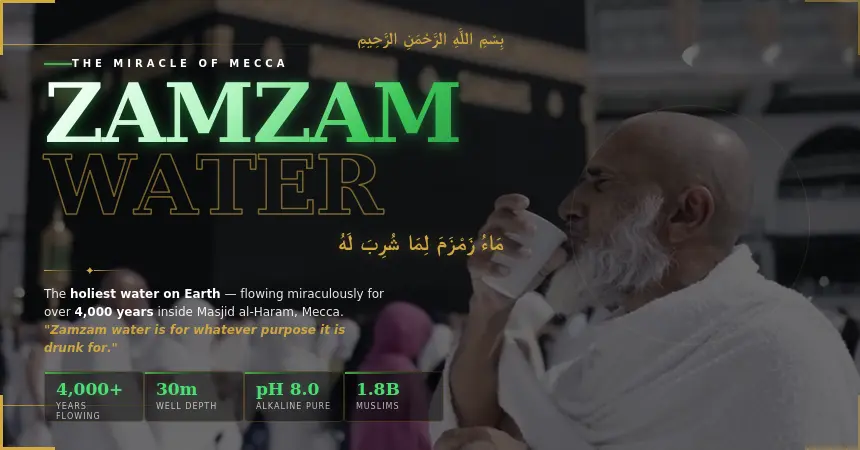
The well is 30 to 31 meters in depth, with the water degree normally maintained at around 3 metres beneath the floor due to constant pumping.and officially monitored by the Saudi Government.
The source of the water comes from Wadi Ibrahim, the valley of Ibrahim, fed by underground springs inside the surrounding mountains.
According to the Saudi Geological Survey, the water is drawn from an aquifer machine fed by means of rainwater accumulated within the hills surrounding Mecca.
Scientists additionally gave their extensive studies and theories approximately the zamzam water well. It additionally amazed many secular scientists.
Zamzam water contains a wonderful mineral composition that differs from regular water. Key characteristics encompass:
Slightly alkaline pH generally among 7.9 and 8.0, that is considered beneficial for human health.
Higher mineral content than widespread drinking water, but safe for consumption.
Contains trace amounts of Nigella sativa compounds (black seed) in line with a few analyses.
One of the most scientifically terrific factors of Zamzam is that despite millions of litres being consumed daily, the well has in no way run dry in over 4,000 years. The Saudi Geological Survey has studied the aquifer and found its far fed via an active underground water gadget linked to the surrounding mountains via Wadi Ibrahim. Even throughout maximum consumption durations together with the Hajj season while up to a few million pilgrims are given the water degree drops most effectively in brief earlier than unexpectedly convalescing.
Japanese scientist Dr. Masaru Emoto, recognised for his water crystal images, reportedly discovered that Zamzam water produced uniquely stunning crystal formations even though this research stays in the realm of popular technological know-how in place of peer-reviewed examination. Regardless, many Muslims consider this as similar evidence of the water's unique nature.
While the Zamzam Well isn't referred to through name inside the Quran, the tale of Hagar and Ishmael is referenced in Surah Ibrahim (Chapter 14) whilst Ibrahim prays: "Our Lord, I actually have settled some of my descendants in an uncultivated valley near Your sacred House..." The massive information comes from Hadith, the sayings and traditions of the Prophet Muhammad (PBUH).
In some other famous Hadith narrated by Ibn Abbas, the Prophet (PBUH) stated: "The water of Zamzam is for something motive it's far under the influence of alcohol for." This means that if someone drinks it with an honest aim for healing, for know-how, for sustenance Allah may additionally fulfil that intention.
Pilgrims are endorsed to drink Zamzam facing the Kaaba, even standing, and to supplicate (make dua) as they drink.
According to numerous Hadith and Islamic scholarly way of life, Zamzam water is described as:
A meal that satisfies starvation
A therapy for contamination whilst consumed with the proper aim
Blessed water that cleanses sins
A manner of pleasurable supplication and dua
Protection from the evil eye and spiritual harm
Before drinking, make an honest aim for something beneficial (understanding, fitness, forgiveness, and so forth).
The Prophet ﷺ stated:
“The water of Zamzam is for something it's far inebriated for.”
Common dua:
Arabic:
اللَّهُمَّ إِنِّي أَسْأَلُكَ عِلْمًا نَافِعًا وَرِزْقًا وَاسِعًا وَشِفَاءً مِنْ كُلِّ دَاءٍ
Meaning:
“O Allah, I ask You for beneficial information, abundant provision, and remedy from each contamination.”
It is suggested (mustahabb) to face the Kaaba at the same time as drinking if feasible.
Start by means of pronouncing Bismillah (In the name of Allah).
Drink it in 3 breaths/sips, now not in a single gulp, just like the Sunnah of drinking water.
Scholars mention it's far advocated to drink completely till you sense happiness, displaying appreciation for the blessing.
Say Alhamdulillah after completing.
Some partners like Abdullah ibn Abbas used to pour some Zamzam water over their heads as a blessing.
The Saudi government has developed an advanced system to pump, filter out, store, and distribute the water. Large cooling containers and dispensers are placed throughout the mosque so pilgrims can drink it without difficulty. The water is also bottled on the King Abdullah Zamzam Water Project facility and supplied to pilgrims at regulated outlets.
Visitors can also fill small bottles for non-public use. The Saudi government permits pilgrims to take limited portions of officially packaged Zamzam water while leaving Mecca, commonly through unique airport distribution factors.
Advanced filtration, trying out, and monitoring systems are used to keep its purity. Organizations consisting of the Saudi Geological Survey often reveal the well's water stages and fine, ensuring that millions of pilgrims traveling to Mecca each year can competently get admission to this sacred water.
The Zamzam Well is far greater than a water source; it's miles a residing miracle that has sustained Mecca for over 4 millennia. Its waters deliver the memory of Hagar's acceptance as true within Allah, Ibrahim's obedience, and Ishmael's blessed existence. From the Quran and Hadith to trendy scientific studies, Zamzam water continues to command surprise and reverence.
Zamzam water is considered special because of its superb starting place and its connection to the story of Hajar and Ismail. Muslims consider that Allah prompted the water to spring from the floor when Hajar desperately searched for water for her baby. It has persisted to waft for hundreds of years and is associated with spiritual benefits and restoration.
The name “Zamzam” is believed to come back from the Arabic word that imitates the sound of flowing or amassing water. According to Islamic culture, Hajar said “Zamzam,” that means “stop flowing,” even as amassing the water so it might now not spread throughout the desolate tract.
In Islamic notion, Zamzam water can deliver restoration whilst it is under the influence of alcohol with sincere purpose and prayer. There is a famous pronunciation of Prophet Muhammad (peace be upon him) that Zamzam water is for some purpose consumed. While many people consider it allowed with fitness and spiritual proper-being, it should now not replace clinical treatment.
Zamzam water does not wreck without problems and can be stored for long periods if stored properly. Because of its unique mineral composition and cleanliness, it tends to stay fresh for a long term in comparison to everyday water.
Muslims drink Zamzam water for non secular blessings, at some point of Hajj and Umrah rituals, and while making prayers or supplications. It is likewise often taken home as a gift for a circle of relatives and friends, and lots of human beings drink it while seeking recovery, strength, or blessings.
The Zamzam Well is positioned in the courtyard of Masjid al-Haram in Mecca, approximately 20 meters from the Kaaba. Today the site itself is underground, and pilgrims receive the water via mainly established distribution systems within the mosque.
Zamzam water does not have a strict expiration date, however like any natural water, it ought to be stored in easy containers. When sealed and saved properly, it is able to remain safe to drink for a long time.
Islamic lifestyle states that the water appeared whilst Angel Jibreel (Gabriel) struck the floor or the ground opened close to child Ismail. Water started to gush out, saving Hajar and her son from thirst inside the wilderness.
The unique discovery is connected to Hajar While the water seemed for her son Ismail. Many years later, the niece had come to be buried and rediscovered by the means of Abdul Muttalib after he reportedly noticed goals guiding him to its area.
The Zamzam itself isn't always stated by name within the Quran, however the tale of Hajar and Prophet Ibrahim’s own family within the valley of Mecca is referenced, and the specified story of Zamzam comes from Hadith and Islamic historic traditions.
Yes, Muslims take into account Zamzam water holy as it originated via a miracle connected to Prophet Ibrahim’s own family and has been utilized by millions of believers for religious functions for hundreds of years.
Many people say that Zamzam water tastes barely extraordinary from ordinary water due to its mineral content. It is normally defined as pure, easy, and slightly heavier than normal consuming water.
Yes, Zamzam water is often examined and monitored by the Saudi government to ensure its safety. Modern filtration and quality control structures maintain it clean and safe for millions of pilgrims.
Scientists believe it is hooked up to a big underground aquifer that continuously refills it. For Muslims, this non-stop supply is likewise seen as a miracle that has lasted for thousands of years despite large consumption.
According to Islamic traditions, Prophet Muhammad (peace be upon him) drank Zamzam water while in status. Because of this, many Muslims prefer to drink it, even though it continues to be permissible to drink it even while sitting.
Yes, toddlers and youngsters can drink Zamzam water in small amounts just like normal water, as it is clean and secure to eat.
Islamic way of life states that Zamzam first appeared lots of years in the past all through the time of Prophet Ibrahim and his son Prophet Ismail.
Zamzam water performs an essential position in the pilgrimage rituals of Hajj and Umrah. Pilgrims drink it throughout their visit to the Kaaba and regularly take it home as a blessed memento of their spiritual journey.
Zamzam water is officially disbursed in Saudi Arabia, mainly in Mecca and Medina. Pilgrims also can purchase sealed bottles at airports such as King Abdulaziz International Airport when returning from Hajj or Umrah.
At King Abdulaziz International Airport, a well-known 5-liter sealed bottle of Zamzam water is usually sold to pilgrims for around 8–10 Saudi Riyals, although expenses can be traded barely depending on rules.