وَإِذْ يَرْفَعُ إِبْرَاهِيمُ الْقَوَاعِدَ مِنَ الْبَيْتِ وَإِسْمَاعِيلُ رَبَّنَا تَقَبَّلْ مِنَّا إِنَّكَ أَنتَ السَّمِيعُ الْعَلِيمُ
Translation: "And [remember] when Abraham and [his son] Ishmael were raising the foundations of the House, [saying], 'Our Lord, accept this from us. Indeed, You are the All-Hearing, the All-Knowing.'" (Surah Al-Baqarah, 2:127)
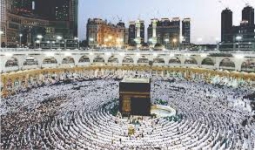
The holy Kaaba holds immense importance to the Muslim Ummah as it is considered the heart of Islam. Located inside Masjid Al Haram in Mecca, it is one of the most sacred sites visited by Muslims for Umrah, Hajj, and prayer. Imagine a pilgrim, having journeyed thousands of miles, finally approaching the grand Masjid Al Haram. The air is filled with a sense of devotion and anticipation. As they step closer to the holy Kaaba, a wave of spiritual energy and deep reverence washes over them, the culmination of a lifetime's aspiration.
According to Islamic tradition, the Kaaba was built by the Prophet Ibrahim (Abraham) and his son Ismail (Ishmael) as the first house of worship dedicated to Almighty God.
Over centuries, it has remained a unifying focal point for Muslims worldwide, symbolizing unity, devotion, and spiritual connection. The Ummah of Muslims, wherever they are located, deeply reveres this sacred site.
"وَإِذْ جَعَلْنَا الْبَيْتَ مَثَابَةً لِّلنَّاسِ وَأَمْنًا وَاتَّخِذُوا مِن مَّقَامِ إِبْرَاهِيمَ مُصَلًّى ۖ وَعَهِدْنَا إِلَىٰ إِبْرَاهِيمَ وَإِسْمَاعِيلَ أَن طَهِّرَا بَيْتِيَ لِلطَّائِفِينَ وَالْعَاكِفِينَ وَالرُّكَّعِ السُّجُودِ"
And We charged Abraham and Ishmael, [saying], 'Purify My House for those who perform Tawaf and those who are staying [there] for worship and those who bow and prostrate [in prayer]
Surah Al-Baqarah, 2:125
The Kaaba is considered one of the most important sites for the muslim ummah. Millions of Muslims travel from various countries to perform umrah. It’s one of the busiest places around the Muslim holy places. The hajj and umrah are performed around here. It’s our “Qibla awal”. There is a restriction on entering the Kaaba. Some of the logistics and some are spiritual.
As we know, millions of muslims perform Umrah together. Due to the immense volume, they have to be more careful if they allow immense amounts of muslims to enter. It will also create chaos and safety risks.
Another big reason is the importance of performing hajj and umrah. The Kaaba and Masjid Al Haram exist primarily for tawaf, prayers, and Islamic rituals. Opening the Kaaba for curiosity could shift focus from these essential rituals, diminishing their spiritual significance.
The security of the Kaaba is with the Al-Shaibi Family. The family is famous for holding keys and cleaning. They hold the ceremony and the cleaning staff. During the conquest of Mecca, our beloved Prophet gave the key to Bani Shaiba (Uthman ibn Talhah) and said (Sahih hadith, Bukhari):
"Take it, O Bani Talha, eternally up to the Day of Resurrection, and it will not be taken from you unless by an unjust, oppressive tyrant."
إِنَّ اللّٰهَ يَأْمُرُكُمْ أَن تُؤَدُّوا الْأَمَانَاتِ إِلَىٰ أَهْلِهَا
Translation (Qur'an 4:58, partial): "Indeed, Allah commands you to render trusts to whom they are due..."
Before the Islamic Revolution, many rulers tried to damage the Kaaba, but they could not succeed. The reason is that the Kaaba was always protected by God Almighty in some way. One of the famous battles associated with this divine protection is between the people of the Kaaba and Abraha, known as the year of the elephant. This story invites us to reflect on what "protection" means across various faith traditions.
In Christianity, for instance, the Holy Sepulchre has long been regarded as a site of divine guardianship, where historical and spiritual preservation has played a critical role. Similarly, the Ark of the Covenant is venerated in both Judaism and Christianity as a symbol of God's promise and protection. These parallels to the Kaaba's own history of divine safeguarding underscore a universal theme of sacred protection and divine guardianship across these faiths.
This year of the elephant is between 570 and 571 CE. Our Prophet Muhammad was born this year.
The year also represents the Abraha ruler from Yemen, who was a Christian, who tried to attack Mecca and the Kaaba. He also thought he would be replaced with the kaaba, to the Christian place name Al-Qullays.
Having said that, he attempted to attack with thousands of elephants, led by the main elephant named Muhammad at the forefront. When the people of Mecca gathered for a united defense, it was the tribes of Quraysh, Banu Kinanah, Banu Khuza'a, and Banu Hudhayl who stood together to battle against this formidable force. Despite their united efforts, they were ultimately unsuccessful. As they approached the Kaaba, Abraha's lead elephant, Muhammad, halted and refused to move forward, while divine intervention through a flock of birds, sent by god, delivered stones upon Abraha's forces, overwhelming them in a display of divine protection and reverence.
At the same time, god sends a group of flying birds with stones near the kaaba. One of their leader is also known as Ababil. They thought stones on the forces of Abraha and smashed like peanuts.
The story is also discussed in the Quran.
"أَلَمْ تَرَ كَيْفَ فَعَلَ رَبُّكَ بِأَصْحَابِ الْفِيلِ"
"Have you not considered, [O Muhammad], how your Lord dealt with the companions of the elephant?" Surah Al-Fil, 105:1
According to Islamic tradition, the Kaaba was always in the hands of the Quraysh, who are considered to be the ancestors of the Prophet Abraham's religion.
"لِإِيلَافِ قُرَيْشٍ * إِيلَافِهِمْ رِحْلَةَ الشِّتَاءِ وَالصَّيْفِ"
"For the accustomed security of Quraysh - Their accustomed security [in] their journeys of winter and summer -"
Surah Quraysh, 106:1-2
The history of Mecca is dear to every community because the Abrahamic religion was established and maintained by Prophet Ibrahim A.S and his sons.
Mecca was honored by Prophet Ibrahim and his son Ismail A.S. During Prophet Ibrahim's era, the Kaaba was restored and regained its significance. The Zamzam well also remained in good condition.
(And [mention] when Abraham was raising the foundations of the House and [with him] Ishmael...)
Qur'an 2:127
When Hajar found the water, she said, "Zamzam!" The Prophet {PBUH}$) said, "May Allah bestow mercy on Ishmael's mother! Had she left the water flow without trying to control it, Zamzam would have been a stream flowing on the surface of the earth."
After many years, followers of the Kaaba, later called Pagans, became corrupted. They started inviting idols into the Kaaba. This shift toward idolatry began to affect daily life in Mecca profoundly. What was once a sanctuary became a center of economic and social activity centered around idol worship, drawing traders and pilgrims who venerated numerous deities.
Idol worship in the Kaaba grew so prevalent that, generations later, God sent the Prophet Muhammad from the Quraysh Tribe. The Quraysh Tribe was one of the most renowned and wealthy tribes in Mecca. There were 360 idols before Islamic civilization.
The Quraysh tribe was dominant in Mecca, exerting control over all matters, including power and custodianship of the Kaaba. They maintained significant influence in many areas, from agriculture to economic wealth, displaying strategic mastery.
The core of the Quraysh tribe's power lay in their role as the guardians and caretakers of the Kaaba. One of their noble personalities was Qusayy ibn Kilab, who demonstrated great leadership and put the tribe on the Mecca map. An example of his strategic brilliance was when he diplomatically relocated several clans to centralize their power base. He gathered all the people of the clans and took control of the Kuza’ah tribe, leading to a more structured and unified leadership. After consolidating power, he further divided responsibilities among the clans, ensuring efficient governance and cohesion.
Siqāyah
Providing water for the pilgrims.
Rifādah
Providing food and hospitality for the pilgrims.
Hijābah
Guarding the Kaaba's key (a role that ultimately passed to the Banu Shaybah clan).
Trading Hub
The Quraysh tribe's deep religious association with the Kaaba fueled their wealth, making Mecca a major commercial center in Arabia. This prosperity wasn't isolated from spirituality; it underpinned a symbiotic relationship between commerce and faith. The influx of trade revenue facilitated by the Quraysh allowed for the generous hospitality offered to pilgrims visiting the Kaaba. This hospitality reinforced the sacred aura of the Kaaba, as the wealth generated through trade directly contributed to the religious experience of pilgrims, creating a harmonious blend of economic and spiritual enrichment.
The annual Hajj season brought tribes from all over Arabia to Mecca, generating huge amounts of revenue through trade, offerings, and taxes. The Quraysh managed and profited from this influx.
● Custodial Role: The Quraysh tribe was the main custodian of the Kaaba in the pre-Islamic period
● Source of Power: The control and guardianship of major Mecca centers for trading and visiting holy places were granted by Quraysh. They also have political and economic control through agriculture.
● This guardianship established Mecca as the major center for trade and pilgrimage, granting the Quraysh immense political and economic authority across Arabia.
● Regional Dominance: As we know, the Quraysh tribe controls the heart of Mecca city, and the heart is the Kaaba. This also concludes social and political dynamics.
● Trade Facilitation: After controlling almost everything in Mecca, they also provide security and assistance to trade in Mecca.
● Religious Axis: The Tribe and their leadership make sure that the Kaaba will always be the central religious site.
"Indeed, the first House [of worship] established for mankind was that at Bakkah (Mecca) - blessed and a guidance for the worlds." (Surah Aal-e-Imran, 3:96: "إِنَّ أَوَّلَ بَيْتٍ وُضِعَ لِلنَّاسِ لَلَّذِي بِبَكَّةَ مُبَارَكًا وَهُدًى لِّلْعَالَمِينَ").
● Pre-Islamic Context: Before Islamic Civilization, the kaaba was a central sanctuary for the Quraysh tribe, who controlled social, economic, and political dominance in Mecca.
● Early Islamic Change: The Prophetic Era marks the fundamental transformation of the Kaaba from idolism to a monotheistic, universal center of Islam around 624 CE.
● The Qibla (Direction of Prayer): In the Early muslim era, they used to face Bayt al-Maqdis (Jerusalem). After the Islamic civilization, the Kaaba became the Qibal awal of the muslim ummah.
● Purification of the Kaaba: After conquering Mecca, the kaaba was purified from pagans, images, and idols. There were almost 360 idols in the Kaaba that were cleaned.
● Re-dedication: In simple words, Prophet Ibrahim A.S.'s religion was restored. Only one God.
● The Universal Hajj: After re-establishing Prophet Ibrahim A.S.'s religion, Hajj becomes the pillar of Islam.
The Significance of Praying Inside the Kaaba is
● A Rare Privilege
● Symbolism of Prayer Direction (Qibla)
● Prophetic Precedent
● Structural Constraints
● Focus on Global Unity
(Surah Al-Hajj, 22:25: "إِنَّ الَّذِينَ كَفَرُوا وَيَصُدُّونَ عَن سَبِيلِ اللَّهِ وَالْمَسْجِدِ الْحَرَامِ الَّذِي جَعَلْنَاهُ لِلنَّاسِ سَوَاءً الْعَاكِفُ فِيهِ وَالْبَادِ").
"Indeed, those who disbelieved and avert [people] from the way of Allah and [from] Al-Masjid Al-Haram, which We appointed for all people - those who reside there and those who visit..."
● Current State: The current state is solely dedicated to God, which reflects the core monotheistic nature of Islam.
● Intentional Sparsity: After the Mecca victory over pagans, the Kaaba was cleaned by Prophet Muhammad, and only three pillars, suspended lamps and an inscription were retained there.
● Purpose Alignment: The interior of the Kaaba represents that only one God (Ahud) is worshipable. He is unseen and present everywhere.
"إِنَّ أَوَّلَ بَيْتٍ وُضِعَ لِلنَّاسِ لَلَّذِي بِبَكَّةَ مُبَارَكًا"
("Indeed, the first House [of worship] established for mankind was that at Bakkah [Mecca]...") (Surah Aal-e-Imran, 3:96).
● The Transition: The evolution of the Kaaba represents the Kaaba’s transition from a local shrine into a global religious icon.
● Rare Privilege: Access to the Kaaba is only given by the Saudi government to notable Muslim figures around the world.
● Access Occasion: The door is mostly open a couple of times a year just for ceremonial washing and cleaning, an act of great reverence.
● Highly Controlled Access: The Interior access to the Kaaba can be given only by custodians. The King and Saudi government officials. They can invite a foreign notable figure.
● Sacred Rites: The timing and rules of rituals are governed by the custodian of notable families (the king) and other famous figures.
● Mandatory Observances: Muslims from all around the world are commanded to perform rituals associated with the sanctuary. These are Safa and Marwah.
"إِنَّ الصَّفَا وَالْمَرْوَةَ مِن شَعَائِرِ اللَّهِ ۖ فَمَنْ حَجَّ الْبَيْتَ أَوِ اعْتَمَرَ فَلَا جُنَاحَ عَلَيْهِ أَن يَطَّوَّفَ بِهِمَا"
("Indeed, [the mountains of] As-Safa and Al-Marwah are among the symbols of Allah...")
(Surah Al-Baqarah, 2:158)
● Unity of the Ummah (وحدة الأمة): The purpose of the Kaaba is to unite the Muslim Ummah, emphasizing that, regardless of origin, all Muslims are equal. Thus, the Qibla serves as our universal focal point. A Nigerian pilgrim once shared, 'Standing before the Kaaba among brothers and sisters from across the globe, I truly feel the unity of our faith.' Similarly, an Indonesian pilgrim remarked on how each step around the Kaaba is a shared journey with fellow believers, solidifying the bond of the Ummah.
● Obedience to Command (طاعة الأمر الإلهي): While inside the Kaaba, we must worship Almighty God, not the Kaaba itself. The Kaaba is simply our direction toward the Almighty.
● Following Prophetic Precedent (اتباع السنة النبوية): In addition, these rituals towards the Kaaba are practices taken from our Prophet Muhammad after shifting from Jerusalem (Bayt al-Maqdis). So we also have to respect that.\
● The Kaaba also gives spiritual significance, acting as the Spiritual Center, representing the heart of Islam. It is the Mark of Submission (علامة الخضوع), as facing the Kaaba demonstrates submission to God's will in Salah. Whether inside or outside the Kaaba, it is the direction for prayers, preventing confusion and promoting faith in God. Visiting it enhances focus.
After the Mecca victory over the pagans, the Kaaba was cleaned by the Prophet Muhammad. Only three pillars, suspended lamps, and an inscription remained inside.
The rules and timing for entering the Kaaba are controlled by the Saudi government. Only notable Muslim figures who receive special permission from the government are allowed access inside the Kaaba.
Due to the large crowds during Umrah, allowing many people to enter the Kaaba would create safety risks and chaos. For this reason, the Saudi government decides which notable Muslim figures are allowed to enter.
Nearly 360 idols were once housed in the Kaaba before it was cleansed. In other words, the religion of Prophet Ibrahim A.S. was restored. Some of the most famous idols included Hubal (هُبَل), Al-Laat (ٱللَّات), Al-Uzza (ٱلْعُزَّىٰ), Manaat (مَنَاة), Isaaf, and Na'ilah (إِسَاف و نَائِلَة).
After Mecca was conquered, only three pillars, lamps, and an inscription remained inside, following its purification by the Prophet Muhammad and his companions.